Updated: Jan 9
In the luxury interior design world, pitching is often seen as a standard part of the process, an elegant dance between presenting ideas, articulating expertise and understanding a client’s aspirations. After more than two decades designing, we have learned that pitching is far less about winning and far more about discovering alignment.
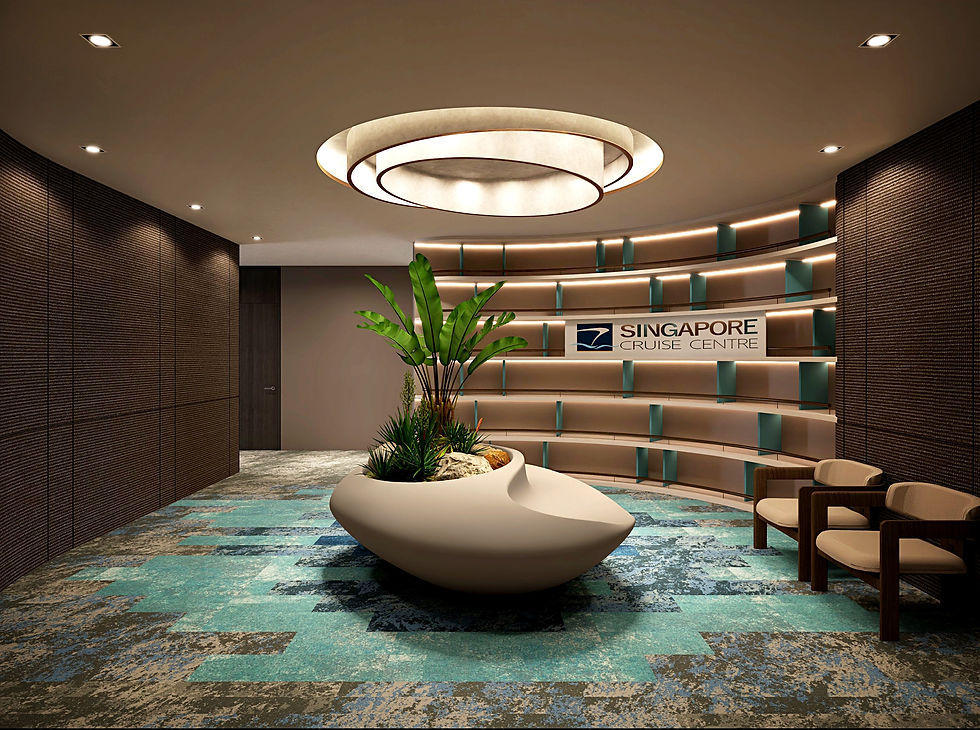
This truth surfaced again during our recent pitch for the Singapore Cruise Centre Headquarters. It involves a demanding strategic thinking, brand interpretation and sensitivity to how a corporate office could evolve into a more inspiring, future-ready space. While our narrative was thoughtful and grounded in design intelligence, the project ultimately went in a different direction.
What might once have felt like a loss became, instead, a moment of clarity because pitching, even when unsuccessful, always reveals something essential about who we are as designers and the clients we are meant to serve.

Pitching is not just for the client’s benefit. It is equally a mirror for us. Over the years, we have learned that a pitch reveals whether the relationship is right. GCB projects, for example, require a level of sensitivity, patience and intimacy that not every client-designer pairing naturally shares. Forbes-listed families and UHNW homeowners often bring multiple stakeholders into the process examples parents, children, advisors, even asset or estate managers. The alignment must be more than aesthetic; it must be personal. When a pitch does not convert, it frequently signals that the deeper synergy was missing. In this tier of design, “almost aligned” is not enough. The relationship must feel effortless, intuitive and respectful from the beginning.

Family offices, too, operate differently from individual homeowners. Their projects may involve spaces used for governance, private meetings, legacy planning or multi-generational convening. These require a designer who can interpret hierarchy, confidentiality and flow without ever compromising on refinement. Corporate offices, on the other hand, like those in the finance, maritime or technology sectors, require a balance between brand expression, staff wellbeing and operational efficiency. Pitching to these clients sharpens our ability to shift between intimate scale and organizational complexity, reminding us that design intelligence is adaptable, not fixed.

Each pitch, whether for a GCB, a Forbes-listed family, a family office or a corporate HQ, becomes a moment of articulation. It forces us to refine our design voice, revisit our principles and sharpen the way we communicate discreet luxury.
Even when a pitch does not result in a commission, the insights gained are invaluable. We understand more clearly the clients we want to serve, the homes and offices we are meant to design, and the level of connection we seek in every collaboration. In luxury design, the winning is not in securing every project. It is in pursuing only the right ones. And often, the pitches we do not win illuminate this path far more clearly than the ones we do.
What we learnt from not winning the pitch is this: pitching is not about validation; it is about direction. It helps us remain intentional, selective and deeply grounded in our design philosophy. In the world of discreet luxury where elegance is quiet, confidence is understated and relationships run deep with every pitch shapes our evolution. The journey is not defined by the number of projects we secure, but by the clarity we gain along the way, guiding us to the GCB families, Forbes-listed households, family offices and corporate leaders who resonate with our craft and trust our vision.

Comments