Updated: Jan 20
As an interior designer in Singapore working with repeat clients, we see a distinct shift when homes are redesigned for retirement. The brief is no longer about reinvention or visual impact. Instead, it is about alignment - how a home supports daily routines, personal interests, and the quieter rhythms of life that emerge over time. These projects are less about change for its own sake, and more about refining what already works, so the home continues to feel right for the years ahead.
When clients return to redesign their homes for retirement, the brief is rarely about reinvention. More often, it is about realignment. The home is no longer asked to impress or perform. Instead, it is shaped to support daily rituals, long conversations, personal interests, and a quieter, intentional rhythm of living.
At this stage, design becomes deeply personal. The decisions are not louder; they are more precise.
Across several repeat client homes, we observed how priorities evolve when people design not for the next phase, but for the one they intend to stay in.
When the Living Room Moves Upstairs
Designing Homes Around How Guests Actually Gather

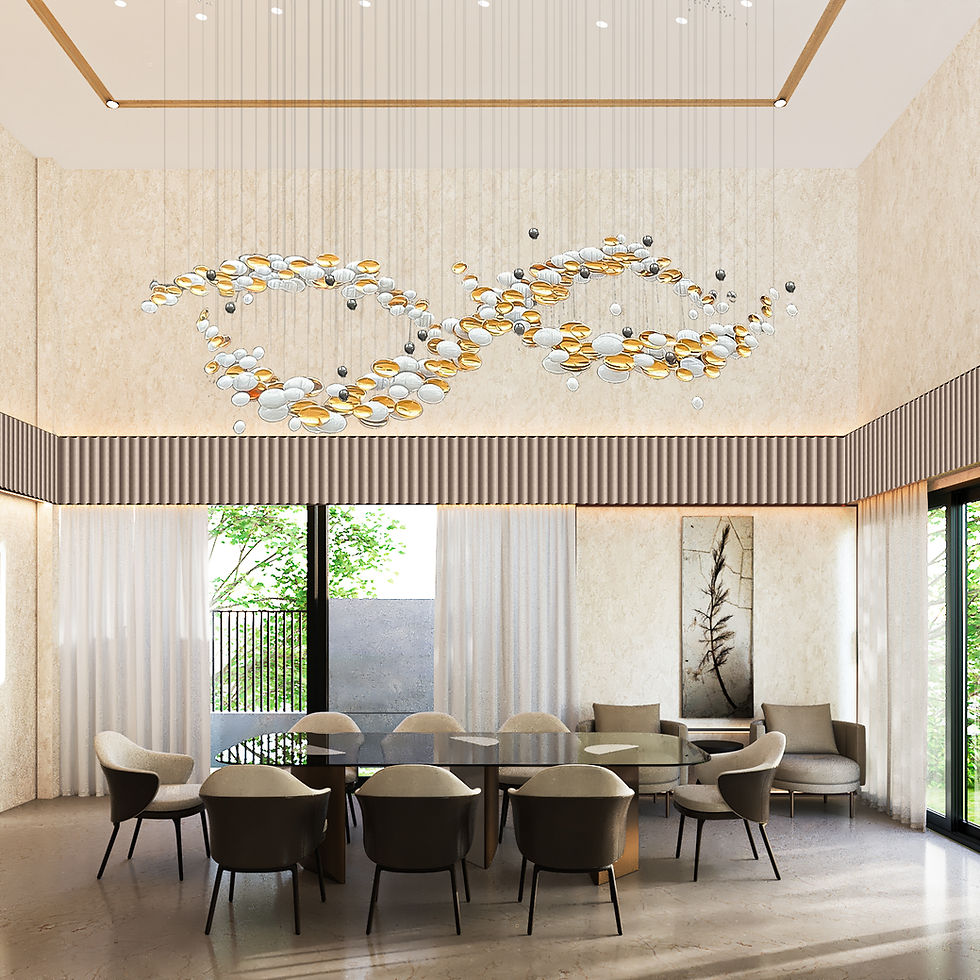
Some homes reveal showpiece living rooms that are rarely used. For one repeat client, retirement prompted a rethink. The living space was relocated to the mezzanine level, away from the usual allocation on the first floor.
This elevated space became where conversations lingered, visits felt unhurried, and hosting turned informal. From this elevated perch, the home’s statement lighting from Sans Souci’s graceful Bowls collection by Katarina Lukačková can be fully appreciated. Custom-configured as an auspicious formation of the figure eight for prosperity, the fixture’s crystalline rhythm catches light and shadow in a poetic play, reveals itself differently from each level, and reaffirms the home’s elegant yet quietly celebratory spirit. Suspended in a flowing composition, it forms a quiet yet striking statement that reads as art rather than ornament.
The result was not a dramatic transformation, but a meaningful one: a home with less visual friction and more ease in daily living. In homes redesigned for long-term living, small decisions often carry the greatest impact. In this same home, a necessary distribution board sat prominently facing the main entrance, technically essential, yet visually disruptive.

Rather than concealing it behind a conventional door, the solution was to integrate it into the architecture itself. The wall was treated as a continuous volume, wrapped in a consistent material language and detailed with precise panel lines that quietly allow access without drawing attention. The result is not a feature, but a sense of calm. Services remain fully functional, yet visually absent, allowing the space to feel resolved, intentional, and easy to live with over time.



Comments